MVHR gives airtight homes filtered fresh air while recovering 70 to 95 per cent of the heat from extract air. On new builds and deep retrofits it cuts heating bills, controls humidity, and helps meet UK Building Regulations Part F. This guide covers when MVHR is worth it, what a good design looks like, and how HES sizes, installs, and commissions systems across Herefordshire.
Modern homes are built tighter than they used to be, and that changes how they need to be ventilated. Trickle vents and open windows worked when houses leaked heat through every joint, but on an airtight self-build or a deep retrofit they stop being enough. Mechanical Ventilation with Heat Recovery is the answer, and getting it right pays back for the life of the building. This is what HES has learned from designing and installing MVHR across Herefordshire, Worcestershire, and Gloucestershire.
What MVHR Actually Does
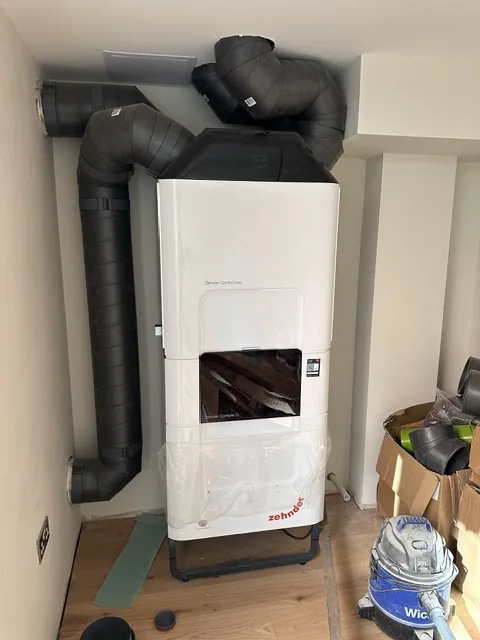
An MVHR system is a whole-house ventilation strategy driven by a single central unit. It pulls stale, moist air out of kitchens, bathrooms, and utility rooms, and it pushes filtered fresh air into bedrooms and living rooms. In the middle sits a heat exchanger that transfers between 70 and 95 per cent of the warmth from the outgoing air to the incoming air, without the two ever mixing.
The practical effect is that an airtight home stays continuously ventilated at low fan speeds, humidity is controlled, allergens and outdoor particulates are filtered, and the heating system does not have to fight a constant flow of cold air arriving through vents. It is the ventilation equivalent of building the house properly rather than patching it later.
When MVHR is Worth It
MVHR earns its keep in properties that are airtight enough to hold the recovered heat. The obvious candidates are new builds designed to modern standards, Passivhaus and low-energy homes, and deep retrofits where insulation and airtightness have been genuinely upgraded rather than superficially improved.
- New builds: Almost always the right time. Ducts are planned before joists and studwork close up, and the unit sits neatly in a plant space rather than being squeezed into an eaves cupboard.
- Passivhaus and low-energy self-builds: MVHR is fundamental to the Passivhaus approach. Without it you cannot hit the ventilation and comfort standards the certification demands.
- Deep retrofits: If you have added external wall insulation, upgraded windows, and taken airtightness seriously, MVHR closes the ventilation loop. Without it a tight retrofit risks condensation and stale air.
- Draughty older properties: Usually not worth it. Too much air leaks around the system to recover meaningful heat, and simpler extract ventilation delivers more per pound spent.
Planning MVHR into Your Build?
Talk to HES on 07780 002416 at design stage. We survey the property, design the duct routes, and commission the system so it runs quietly and efficiently from day one.
Book a Design VisitDesign Pitfalls to Avoid
Most MVHR problems come from design decisions taken too late or too casually. A few things worth flagging early with your architect and installer.
- Ducts squeezed in after joists are cut: If the ducting is an afterthought, routes get twisted, bends multiply, and the system fights itself. Plan duct routes with the structural drawings, not against them.
- Unit sited next to a bedroom wall: Even a quiet unit produces some noise. Site it in a plant room, utility, or garage where residual sound does not matter.
- Undersized ducts: Skinny ducts force fans to work harder, and that is where noise and running costs creep in. Design for generous cross-section from the start.
- Missing acoustic attenuators: Straight duct runs between rooms carry sound as well as air. Attenuators kill the acoustic path between bedrooms and living areas.
- External terminals sited badly: Intake and exhaust need to be far enough apart to avoid short-circuiting, and away from anything that would pull unwanted air into the system.
Every one of these is fixable at design stage and expensive to fix afterwards. That is why HES prefers to be involved from the drawings onwards on any MVHR project.
Filter and Commissioning Best Practice
The two things that decide how well an MVHR system runs after year one are commissioning and filters. Neither is glamorous, both matter.
Commissioning means measuring the actual air flow at every extract and supply terminal, adjusting until the design flow rates are met, and recording the numbers so the system is provably balanced. Any installer who skips this step is guessing rather than commissioning. HES issues a full commissioning report with the flow measurements, which is also what building control expects to see for Part F sign-off.
Filters are the maintenance job that keeps everything else working. Most units run G4 pre-filters as standard with an F7 pollen filter on the supply side, changed every 6 to 12 months depending on local conditions and how much cooking smoke or wood stove use the house sees. We hand over a filter schedule at commissioning and stock the common sizes so replacements are straightforward.
MVHR and Heat Pump Combos
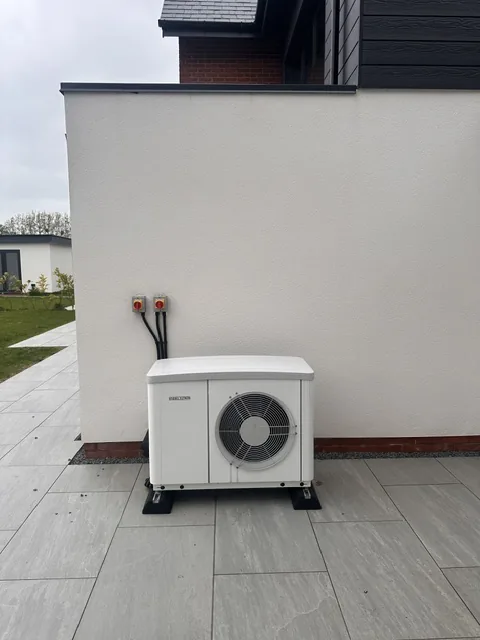
MVHR and heat pumps are the natural pairing for a low-energy home. The heat pump provides steady low-temperature heating that suits a well-insulated envelope, and the MVHR keeps the ventilation heat losses to a fraction of what they would be with trickle vents. Together they deliver comfortable, filtered, quietly warm spaces at running costs that make the design work pay back.
HES designs and installs both, which matters more than it sounds. When the same team specifies the heat pump and the MVHR, the flow temperatures, controls, and set points get planned as one system rather than two. That avoids the common problem of a heat pump sized as if the house had traditional ventilation, or an MVHR system oblivious to the heating strategy sitting alongside it.
Frequently Asked Questions
As a rule of thumb, an air permeability result of 3 m³/hr/m² at 50 Pascals or better is where MVHR really pays off. Passivhaus targets 0.6 air changes per hour, which is much tighter still. On leakier properties you can still fit MVHR, but the heat recovery percentages fall and simpler mechanical extract ventilation may deliver better value.
Not on its own. MVHR is a ventilation system that recovers heat, not a heating system. In a Passivhaus with tiny heating demand the MVHR supply air can carry a small amount of the heating load, but every home still needs a dedicated heat source, typically a heat pump or a small boiler.
A typical domestic MVHR unit takes up roughly the footprint of a small chest freezer, plus clearance around it for duct connections and filter access. Plan for a plant cupboard, utility room, or garage location with easy access, not a sealed loft void.
Yes. MVHR is covered by Building Regulations Part F, which requires design and commissioning documentation. HES provides the commissioning report and flow measurements building control expects, and we work with your building inspector directly if that is easier.